
Would You Rather? Extreme
Night Party AppsTrivia
4.235.00 Reviews
- Version
- 1.1.0
- Installs
- 50.00K
- Age Rating
- Teen
Screenshots
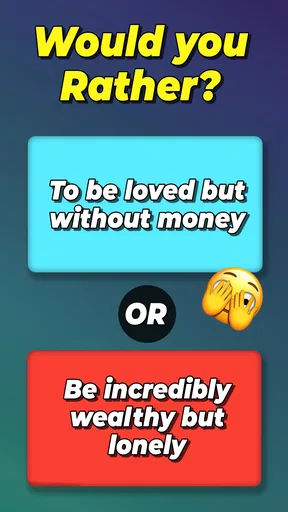
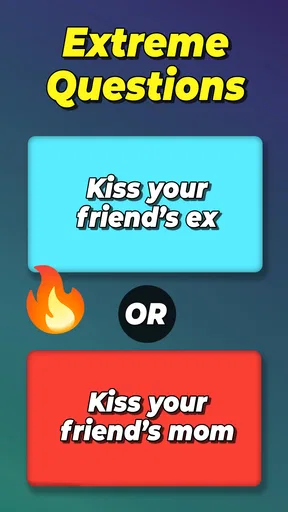
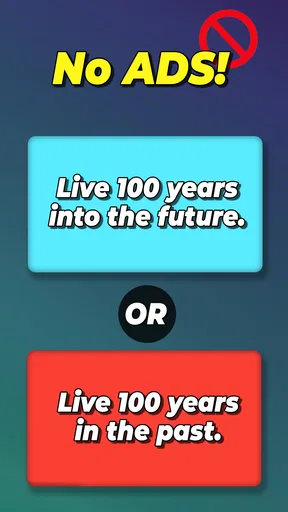
Our Review of Would You Rather? Extreme
 Analysis by Appyee
I tried Would You Rather? Extreme as the kind of game you open when nobody wants to commit to a full board game, but everyone is willing to answer an awkward question. That is where it makes its best first impression. It is a free trivia game from Night Party Apps, built around difficult “would you rather” choices rather than traditional fact-based quizzes. The appeal is immediate: read a dilemma, choose a side, and enjoy the arguments, laughter, or uncomfortable silence that follows.
My first reaction was that the game understands the social value of a question better than the competitive value of a score. You are not really playing to prove knowledge. You are using the prompts to reveal how differently people think. That makes it a natural fit for a group of friends, a casual gathering, or a quiet evening when conversation needs a small push. It is less convincing as a solo pastime, because the interesting part usually begins after the question appears.
Why the first week feels so easy to enjoy
The opening sessions benefit from the simplicity of the format. There is no long tutorial to learn and no complicated setup before a group can start talking. Someone can hold the phone, read a question aloud, and let everyone answer in turn. That low barrier matters, especially when the players are not already familiar with trivia games or when the mood is informal.
The “extreme” angle also gives the game a clearer personality than a mild conversation starter. The questions are intended to challenge friends and make them laugh, so the experience works best when the group is comfortable with unusual, embarrassing, or morally awkward choices. I found that the strongest moments came from the explanations rather than the selections themselves. A person choosing one option is interesting; hearing why they chose it is what keeps the room engaged.
That distinction is useful before downloading it. If you want a conventional quiz with correct answers, categories, and a clear winner, this is not the same experience. Its trivia label points toward question-based entertainment, but the real activity is social debate. There is no need to research anything or prepare beforehand, yet the game can still expose surprisingly different opinions among people who know one another well.
The free entry point makes experimenting easy. At the time of my review, the game carries a 4.2 average from around 720 ratings, which suggests that many players find the central idea enjoyable, while also leaving room for the usual differences in taste with party games. It has passed 50 thousand installs and is marked for Teen audiences, details that fit its focus on provocative questions rather than child-oriented play.
A practical group routine
A useful way to play is to avoid rushing through the prompts. I would give each person a few seconds to choose, then ask one or two players to explain their reasoning. After that, move on before the discussion becomes repetitive. This creates a rhythm of decision, reaction, and short conversation instead of turning every card into a debate that lasts too long.
For a small gathering, one person can act as the reader and rotate that role after several questions. That prevents the phone from becoming the center of attention and makes the session feel more shared. In a larger group, asking everyone to answer before anyone explains can reduce the influence of the first response. People are less likely to copy the loudest friend when they have already made their own choice.
Another useful habit is to agree on boundaries before starting. Because the game is aimed at teens and older players, some prompts may feel too personal for a particular group even when they are harmless in another. I would not use it as an icebreaker with strangers unless someone is prepared to skip questions without making a big issue of it. The game works through openness, but forced openness quickly turns a funny activity into an awkward one.
Where the novelty is strongest
During the first week, the main strength is discovery. Players are still learning who gives practical answers, who chooses the most chaotic option, and who changes their mind after hearing everyone else. That social mapping gives each question more weight than it would have on a screen by itself. A familiar friend’s answer can be funnier than the prompt, and a surprising answer can lead to stories that have nothing to do with the original dilemma.
I also like that the game can fill different amounts of time. You can play a few questions while waiting for food, or keep going during a longer visit. It does not demand a dedicated table, a deck to shuffle, or a winner who must be tracked carefully. That flexibility is a genuine advantage over many traditional party games, especially when the group is already talking and wants a light structure rather than a formal activity.
Still, the first-week appeal depends heavily on the personalities around the phone. A quiet group may run out of energy quickly, while a talkative group can make almost any prompt work. The app supplies the spark, not the entire fire. I would recommend it to friends who enjoy explaining their choices, teasing one another kindly, and accepting that the best answer is sometimes the one that creates the longest conversation.
What remains useful after the first month
The harder question is whether the game earns a permanent place on a phone after the initial curiosity fades. My answer is qualified. It has recurring value as a social tool, but not necessarily as a daily game. I would keep it available for visits, trips, and casual group moments rather than expect to open it alone every day.
Its long-term usefulness comes from changing groups and changing situations. A set of questions that feels familiar with close friends can work differently with siblings, classmates, or a partner. Even when a prompt has been seen before, new players can give it a fresh purpose. That makes the game more reusable than a single-use conversation starter, though it does not make the content infinite.
The most effective monthly routine would be occasional rather than constant. Bring it out when a gathering becomes quiet, use it for a short round, and stop while people are still enjoying themselves. If you treat it as background entertainment instead of a scheduled obligation, it is less likely to feel like homework. In my experience, this kind of game benefits from being slightly underused; leaving some space between sessions protects the surprise.
It can also support different social goals. With close friends, the questions can reveal personal priorities and create playful arguments. With a partner, they can open conversations about risk, comfort, money, or impossible choices without presenting those topics as a serious interview. With a family group, careful skipping is more important, but the format can still work when everyone understands that the answers are for discussion rather than judgment.
How it compares with familiar alternatives
Compared with a standard trivia app, this game has less emphasis on knowledge and more on personality. A traditional quiz gives you a measurable result and a reason to replay: improve accuracy, beat a previous score, or learn new facts. Would You Rather? Extreme offers none of that same pressure. Its reward is the reaction around the question, so it is better for conversation than self-improvement.
Compared with a physical party card game, it is more convenient because there is no box to carry or deck to organize. A phone is usually already nearby, and one person can start a round quickly. The trade-off is atmosphere. A physical deck gives players something to pass around and can feel more communal, while a phone may pull attention away from the group or make the activity seem less special.
Compared with open-ended conversation prompts, the app gives people a stronger starting point. Asking “what do you want to talk about?” often produces nothing. A forced choice creates an immediate position, and that position can lead somewhere unexpected. The limitation is that the game controls the direction. If your group wants thoughtful, practical, or deeply personal questions, a carefully chosen conversation deck may be a better fit.
Compared with competitive party games, it is forgiving. Nobody needs to be fast, clever, or knowledgeable to participate. That makes it friendly to mixed groups, including people who usually avoid games because they dislike losing. On the other hand, players who need a clear objective may find the lack of scoring unsatisfying. The right alternative depends on whether your group wants connection or competition.
What can create fatigue over time
The biggest long-term weakness is repetition. “Would you rather” questions are easy to understand, but the basic structure does not change much. Once players recognize the common patterns, some prompts may feel interchangeable: choose between two unpleasant outcomes, compare two extreme lifestyles, or decide which inconvenience you would tolerate. The reactions can remain entertaining, but the surprise declines.
Fatigue also appears when every person answers in the same predictable way. If one friend always chooses the least painful option and another always selects the outrageous one, the group may start anticipating the response before the question is finished. A simple way to refresh the session is to ask players to defend the opposite choice after answering. That does not change the app, but it adds a second layer of play and exposes reasoning that the first response may hide.
Another source of friction is the social temperature of the room. Extreme questions can be funny when people trust one another, but they can feel intrusive when the group is new or tired. I would not assume that a Teen content rating makes every prompt suitable for every teen setting. Adults should still consider who is present, and players should be allowed to pass without pressure. That small rule makes the experience more welcoming and prevents one questionable prompt from dominating the evening.
The free model is also worth considering over time. The game itself is free to try, while in-app purchases range from around three dollars to around fifteen dollars per item. That may be reasonable for players who use it often, but occasional users should think about whether extra spending would genuinely extend their enjoyment. I would first establish that the group likes the core format before paying for anything. A purchase cannot solve a mismatch between the game’s style and your friends’ preferences.
Keeping the experience fresh without forcing it
My best maintenance tip is to create your own rotation of play styles. One session can focus on quick answers, another can require explanations, and another can let the group vote on the most surprising response. You can also divide a longer gathering into short rounds separated by normal conversation. These changes keep the app from carrying the entire burden of entertainment.
It helps to match the game to the occasion. On a road trip, it can fill quiet stretches when everyone is awake and willing to talk. At a dinner, it works better after people have settled in than during the first few minutes of meeting. At home, it can be a low-effort alternative to scrolling when two or more people want something interactive but do not want to learn a new ruleset.
I would avoid using it as a substitute for every kind of social activity. If the group wants to tell stories, play music, or have a serious conversation, repeatedly presenting extreme choices may interrupt rather than improve the mood. Its strength is as a catalyst. Use it to open a conversation, then let the conversation become the main event.
Who should install it, and who should skip it
I think it is a good choice for friends who enjoy playful arguments and do not need a winner. It is especially suitable for people looking for a quick group activity that can start and stop without preparation. The age rating and provocative theme make it more appropriate for teen and adult groups that can handle uncomfortable subjects sensibly, rather than for young children or formal family settings.
I would skip it if you mainly play alone, want factual learning, or expect a deep progression system. It is also not ideal for a group that dislikes personal questions, becomes competitive about every answer, or prefers carefully structured board-game rules. In those situations, a conventional quiz, a cooperative game, or a physical card game with clearer boundaries would probably provide more lasting satisfaction.
My own recommendation is to judge it by the people you will play with, not by the promise of endless content. If you already have a lively group, the app can turn spare minutes into memorable conversations. If the group is quiet or uncomfortable with extreme hypotheticals, the same prompts may simply expose that mismatch. No setting or feature can replace willing participation.
Final judgment on its staying power
Night Party Apps has made a focused trivia game rather than an all-purpose party platform. The current version is 1.1.0, and the concept remains easy to understand: choose between difficult alternatives, then see what everyone else thinks. That focus is both its advantage and its limit. It makes the game approachable, but it also means long-term variety depends on the freshness of the questions and the energy of the group.
After the novelty fades, I would keep it installed as a backup for social occasions rather than make it part of my daily routine. The free download lowers the risk, and the first few sessions can be genuinely funny when the right people are involved. Its recurring value comes from using it selectively, changing the way the group discusses answers, and accepting that some evenings will produce better conversations than others.
My final take: it earns space as a lightweight group conversation game, not as a deep standalone trivia experience. Install it if you want a fast way to challenge friends and create playful disagreements. Skip it if you need progression, factual quizzes, or a game that remains equally engaging without a lively audience. Used in the right setting and with sensible boundaries, it can stay useful well beyond the first week, provided you let it appear occasionally instead of asking it to entertain everyone all the time.
Verdict
Strengths of Would You Rather? Extreme
- Quick rounds make it easy to play during short breaks.
- Large variety of unusual questions keeps sessions unpredictable.
- Simple interface is accessible for players of all ages.
- Works well for groups at parties or casual gatherings.
- Answer choices can reveal surprising differences between friends.
Limitations of Would You Rather? Extreme
- Some extreme questions may feel uncomfortable for younger players.
- Replay value can drop once familiar questions start repeating.
- Limited appeal if your group dislikes personal or awkward topics.
- May encourage arguments when players strongly defend their choices.
- The experience depends heavily on having an engaged group to play with.
Similar Picks in This Category
View All
Millionaire 2026 Quiz & Trivia
Quiz & Trivia Games by Submarine Apps4.5

Brain Test 2: Tricky Stories
Unico Studio4.7

Trivia Crack: Brain Quiz Games
etermax4.4

QuizzLand. Quiz & Trivia game
Quiz & Trivia Games by Mno Go Apps4.8

Brain Test: Tricky Puzzles
Unico Studio4.7

Logo Quiz
bubble quiz games4.5
Frequently Asked Questions
What is Would You Rather? Extreme?
Would You Rather? Extreme is a party-style question game built around difficult, funny, embarrassing, and sometimes provocative choices. Players select between two unusual scenarios and can discuss their answers with friends. It is designed mainly for casual group entertainment, making it suitable for parties, trips, sleepovers, or relaxed conversations when everyone is comfortable with the type of questions included.
Is Would You Rather? Extreme suitable for children?
Parents should review the game’s content before allowing children to play. The “Extreme” format may include mature, uncomfortable, suggestive, or otherwise intense questions that are not appropriate for younger players. The app is generally better suited to teenagers and adults, depending on the specific question packs and the group’s preferences. Adult supervision is recommended for family use.
Can I play Would You Rather? Extreme without an internet connection?
The basic question experience may work offline if the required content is already included or downloaded on the device, but some features can depend on an internet connection. Advertising, updates, additional question packs, analytics, or other online services may not function without access to the web. It is best to open the app once before traveling and check which content is available offline.
Does Would You Rather? Extreme contain in-app purchases or advertisements?
The app may use advertising or optional purchases to support development, depending on the platform version and current release. Some question categories, extra packs, or ad-free features may require payment. Before downloading, users should check the store listing for the latest pricing and purchase information. If you are playing in a group, review these options beforehand to avoid unexpected interruptions.
How many people can play Would You Rather? Extreme?
Would You Rather? Extreme is flexible and can be played by two people or a larger group gathered around one phone. There is usually no need for every participant to install the app, since players can take turns reading questions and explaining their choices. The experience is most enjoyable with friends who are willing to debate answers, laugh together, and respect personal boundaries.
Play our best games!


